Updated: July 2026
Wakatobi Live Aboard — Wakatobi Liveaboard Voyages — Coral Tri…
Wakatobi Live Aboard is a curated Indonesia luxury tourism experience offered by Wakatobi Liveaboard Voyages: handpicked routes, vetted operators, transparent pricing, and 24/7 concierge support across Indonesia.
- What makes Wakatobi Live Aboard a premium experience.
- How Wakatobi Liveaboard Voyages curates exclusive access and concierge logistics.
- Routes, seasons, and pricing transparency — no hidden fees.
Wakatobi Liveaboard Voyages — Coral Triangle Dive Expeditions Across Tomia and Hoga
Wakatobi Liveaboard Voyages curates seven to ten day live-aboard dive expeditions through the Wakatobi Marine National Park — Wangi-Wangi, Kaledupa, Tomia, Binongko — for couples, dive clubs, and private charter groups since 2018.
Why Wakatobi Is the Coral Triangle Dive Destination Most Liveaboard Veterans Save for Last
Wakatobi sits at the geographic centre of the Coral Triangle, the global epicentre of marine biodiversity, and the four islands of the archipelago — Wangi-Wangi, Kaledupa, Tomia, and Binongko — give the region its name. The Wakatobi Marine National Park covers 1.39 million hectares of coral reef, mangrove forest, seagrass meadow, and pelagic blue water, and in 2012 UNESCO designated the entire park a World Biosphere Reserve in recognition of its 942 reef-fish species and 750 hard and soft coral species. A Wakatobi liveaboard is the only sensible way to dive the park properly: the best sites sit between Tomia and Hoga, the inter-island distances exceed forty nautical miles, and shore-based day boats simply cannot reach the southern Binongko walls or the Kaledupa channel pinnacles inside a single day.
Wakatobi Liveaboard Voyages is an independent wakatobi liveaboard curator headquartered in Bali with a permanent operations desk at Wanci harbour, Wangi-Wangi. We are not a single-boat operator. We hold framework agreements with seven Indonesian-flagged liveaboards ranging from a 28-metre traditional pinisi running eight cabins for sixteen divers, to a 42-metre purpose-built dive yacht running ten en-suite cabins for twenty divers, to a 53-metre flagship platform running twelve premium suites with private dive butlers. Our flagship Wakatobi liveaboard private charter package is the most-booked product on this site, but every itinerary is custom-built around your dive group’s certification mix, sea-day tolerance, and photography priorities.
The Three Wakatobi Liveaboard Itineraries Most Dive Groups Book
After eight years curating Wakatobi voyages, we have watched booking patterns crystallise into three repeating itineraries. Roughly seventy-five percent of our guests choose one of the three, and the remaining quarter splice elements together for longer charters. Here is the honest split.
1. The 7-Day Tomia and Hoga Classic
You fly Bali → Makassar → Kendari → Wanci, board the liveaboard at Wangi-Wangi harbour by 18:00, and the captain points south overnight to Tomia. The next six days run twenty-two to twenty-four dives across the famous Tomia walls — Roma, Mari Mabuk, Cornucopia, Teluk Maya — the Hoga channel macro sites, and the Kaledupa pinnacles. You disembark at Wanci on day seven, fly out the same afternoon. This is the classic itinerary, and our 7-day private charter package is the version most couples and dive clubs select.
2. The 10-Day Wakatobi Plus Binongko Extension
For experienced divers chasing the southern Binongko walls — sites like Karang Kapota and the Binongko drop-offs that sit two hundred metres deep within twenty metres of shore — we run a ten-day extended itinerary. The first six days mirror the classic, then days seven through nine push south to Binongko for the wall sites, the manta cleaning stations off the southern point, and the seamount pelagics. Disembarkation day ten at Wanci. Roughly thirty dives, advanced certification recommended, and ideal for photography clients who want the macro slow burn followed by the wide-angle finale.
3. The Wakatobi Plus Buton Cross-Strait Voyage
For private-charter groups with twelve to sixteen days, we coordinate the cross-strait voyage from Wakatobi north into the Buton Sea, calling at the Buton Strait cleaning stations, the Hoga macro grounds, and the rarely dived Kabaena coral atoll. This itinerary embarks at Wanci and disembarks at Bau-Bau, Buton, with a charter flight to Makassar arranged by us. It is the longest and most expensive variant, and we run it three or four times per year for repeat-client dive groups.
Why Wakatobi Beats Raja Ampat for Some Dive Groups — and Loses to It for Others
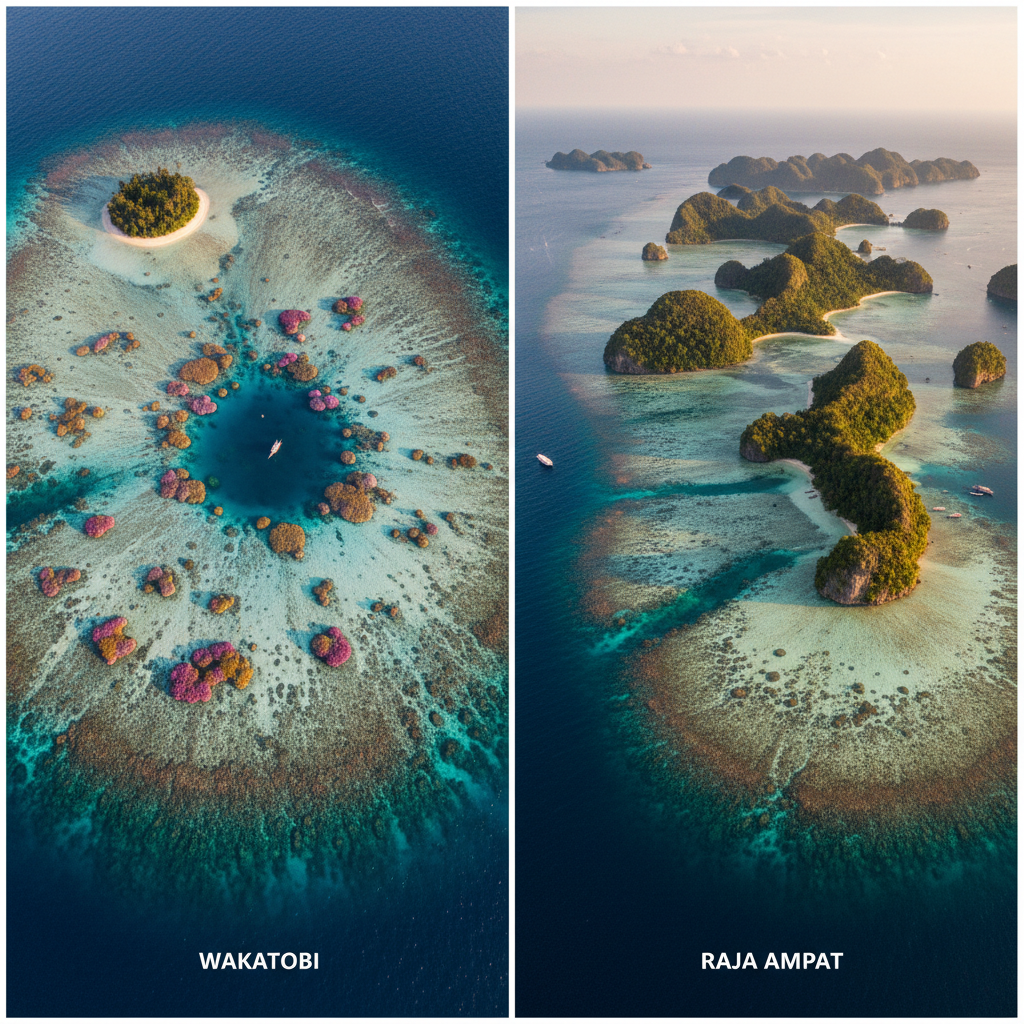
Wakatobi versus Raja Ampat is the single most asked question we field, and we answer it honestly. Wakatobi wins on coral coverage at depth (the Tomia walls show seventy to eighty percent live hard coral cover at twenty-five metres, equal to anywhere on the planet), on diver density (we typically share a Tomia mooring with one other liveaboard, never four), on accessibility from Bali (Bali → Wanci is one travel day; Bali → Sorong is two), and on cost (a comparable Wakatobi charter runs roughly thirty percent below the Raja Ampat equivalent). Raja Ampat wins on pelagic action (the Dampier Strait currents pull in mantas and grey reef sharks reliably), on macro density at Misool, and on photographer reputation. We unpack the full five-axis comparison in our Wakatobi vs Raja Ampat honest comparison.
Wakatobi Resort, Pelagian, and the Independent Liveaboard Market
Wakatobi Resort on Tolandono Island operates the well-known Pelagian dive yacht, and we will say plainly that Pelagian is an excellent product for guests staying at the resort itself. We are an independent curator and we work with seven other Indonesian-flagged operators that run charters of equivalent quality at meaningfully different price points. If you want the resort-tied Pelagian product, we will introduce you directly. If you want the broader liveaboard market with seven boats, four price tiers, and the flexibility of custom itineraries beyond the resort’s anchorage radius, that is what we do. Our role is to match the right boat to your group, your budget, and your dive goals — not to sell you a single product.
Pricing, Inclusions, and What the Charter Actually Costs
A typical Wakatobi liveaboard 7-day charter on our standard tier runs US$2,890 per diver, all-in, for a shared en-suite cabin. Premium tier with private cabin and twin-engine luxury yacht runs US$4,290 per diver. Private full-boat charter for a group of twelve runs US$32,000 to US$58,000 depending on boat tier and season. Inclusions cover all dives (twenty-two on the 7-day, thirty on the 10-day), tanks and weights, full-board chef-prepared meals with seafood emphasis, soft drinks and Indonesian coffee, certified divemaster guides, harbour fees, and the Wakatobi Marine National Park entry permit. Exclusions are the international and domestic flights, dive equipment rental (US$35 per day if needed), Nitrox surcharge, alcohol, and crew gratuity. The complete pricing matrix and seasonal rate variations are documented on our Wakatobi liveaboard cost 2026 pricing guide.
The Practical Travel Logistics from Bali
Wakatobi is not next door, and we will not pretend it is. From Bali Denpasar (DPS) you fly to Makassar (UPG) — the connection hub for eastern Indonesia — then transfer to a domestic carrier (Wings Air or Lion Air) for the flight to Kendari (KDI). From Kendari you take a final ATR turbo-prop to Wanci (WNI) on Wangi-Wangi island, the gateway to the marine park. Total transit is one full travel day. Some itineraries route through the Tomia airstrip (TQQ) directly, which we coordinate when seat availability permits. Our concierge handles the entire flight chain, the airport meet-and-greet at Wanci, and the harbour transfer to your liveaboard. The complete travel route, recommended carriers, and contingency planning is documented in our Wakatobi from Bali travel route guide.
Best Time to Dive Wakatobi — The Seasonal Calendar
Wakatobi is divable year-round, but the visibility, sea state, and pelagic activity vary materially by month. The dry season runs March through November, and the prime window for couples and recreational divers is April through October when surface conditions are glassy and the Tomia walls are at peak visibility. November through March is the green season — heavier rainfall, thirty-percent fewer liveaboard slots, lower prices, and richer plankton blooms that bring manta activity to the cleaning stations. The complete monthly breakdown of visibility, sea temperature, manta probability, and crowd density appears in our best time Wakatobi marine park monthly guide.
Booking, Lead Time, and How the Atelier Process Works
Most wakatobi liveaboard charters book three to nine months in advance. Peak July, August, and the late-October manta window demand the longer lead. The booking process is conversational, not transactional. You message us on WhatsApp at +62 811 3941 4563, we send a one-page consultation questionnaire about your group, your certification mix, and your dive priorities, and we return within four hours with three boat options at three price tiers and a tailored itinerary. A thirty-percent deposit secures the date; the balance is due sixty days before embarkation. We accept bank transfer, Wise, and the major card networks via secure invoice. Cancellation policy mirrors the standard liveaboard industry terms with our standard reschedule grace.
Start Your Wakatobi Liveaboard Plan on WhatsApp [email protected] +62 811 3941 4563
Sources and authority: UNESCO Wakatobi Biosphere Reserve listing for park designation, Coral Triangle Initiative official portal for biodiversity context.